A gravel calculator turns project measurements into an estimate before ordering. Enter the length, width and depth of a driveway, path, patio base, drainage trench or garden area, then convert the result into the supplier’s selling unit. This guide shows how to calculate gravel needed in cubic feet, cubic yards, cubic metres, kilograms, short tons and metric tonnes while accounting for compaction, moisture, waste and local price.
How a Gravel Calculator Works
The basic formula is Volume = Length × Width × Depth.
Measurements must use compatible units. For feet, divide depth in inches by 12 before multiplying. For metres, divide depth in centimetres by 100. Convert the resulting volume into weight using gravel density.
A gravel volume calculator shows how much space material fills, while a gravel weight calculator applies density to estimate mass. Pea gravel, crushed limestone, river rock and recycled aggregate have different shapes and void spaces, so use the supplier’s density whenever possible. Loose, damp or compacted material may weigh differently.
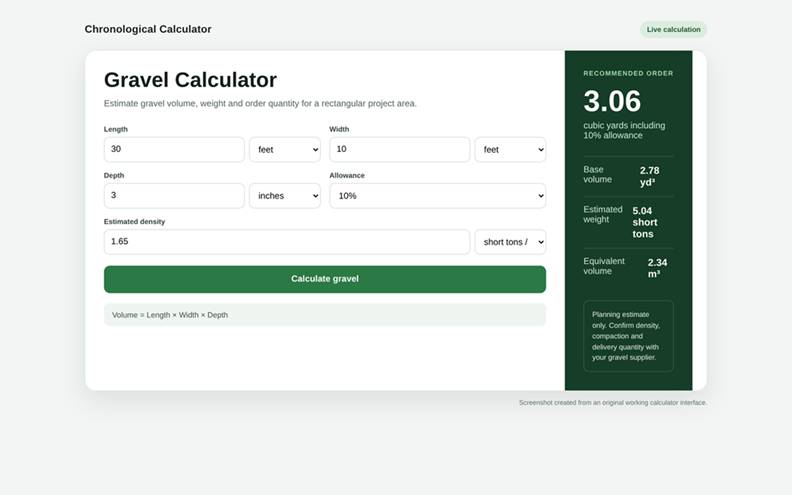
Figure 1. A working gravel calculator converts project dimensions into order volume and weight.
Recommended Ordering Allowance
Add 5% for a measured area and 10% for irregular shapes, settlement, spillage or uncertain depth. Deep sub-bases may compact more than decorative layers. No conversion suits every product.
Gravel Depth Guide
| Project | Depth | Planning note |
| Garden cover | 2 inches or 50 mm | Use fabric where suitable |
| Footpath | 2–3 inches or 50–75 mm | Choose angular gravel |
| Driveway surface | 2–3 inches or 50–75 mm | Place over prepared base |
| Driveway sub-base | 4–8 inches or 100–200 mm | Compact in lifts |
| Drainage trench | As designed | Follow drainage plan |
These are planning ranges, not engineering specifications. Soil strength, traffic, drainage and local requirements may change the design.
Measurement Conversion Table
| Conversion | Method |
| Cubic feet to yards | Divide by 27 |
| Cubic yards to feet | Multiply by 27 |
| Cubic metres to yards | Multiply by 1.308 |
| Cubic yards to metres | Multiply by 0.765 |
| Kilograms to tonnes | Divide by 1,000 |
| Pounds to short tons | Divide by 2,000 |
Select a gravel calculator cubic yards when ordering a project in the US and a gravel calculator cubic metres when ordering a project in a metric supplier. Gravel calculator tons typically refers to US short tons, whereas gravel calculator tonnes refers to metric tonnes. Check the terminology of the supplier.
Worked Gravel Calculations
Example 1: The Cubic driveway is a rectangle in yards.
There is a 30-foot (10 feet wide) driveway that is 3 inches deep. Convert depth: 3 ÷ 12 = 0.25 feet. Volume: 30 × 10 × 0.25 = 75 cubic feet. Convert: 75 ÷ 27 = 2.78 cubic yards. Add 10%: 2.78 × 1.10 = 3.06. Order approximately 3.1 cubic yards.
The P.S.D Hu Foundation, (n.d.)_Example 2: Garden Path in Cubic Metres and Tonnes.
A way is 12 metres long, 1.2 metres wide and 50 millimetres deep. Convert depth: 50 ÷ 1,000 = 0.05 metres. Volume: 12 × 1.2 × 0.05 = 0.72 cubic metres. With a density of 1,700 kilograms per cubic metre, the weight is 0.72 x 1,700 = 1,224 kilograms or 1.224 metric tonnes. Order approximately 1.29 tonnes with 5% allowance.
Scenario 3: Round Seating.
The diameter of a round area is 4 metres and a depth of 75 millimetres. Radius is 2 metres. Area: 3.1416 × 2 × 2 = 12.57 square metres. Volume: 12.57 × 0.075 = 0.943 cubic metres. The weight estimates 1,509 kilograms, at 1,600 kilograms per cubic metre. Multiply by 10 to get approximately 1.66 metric tonnes.
Common Gravel Types and Uses
| Type | Uses | Key trait |
| Pea gravel | Paths, play areas, beds | Rounded but mobile |
| Crushed stone | Driveways, bases, paths | Angular and stable |
| River rock | Borders, drainage, landscaping | Smooth and decorative |
| Decomposed granite | Paths and patios | Compacts firmly |
| Limestone gravel | Driveways, construction | Density varies regionally |
Select material by function, not appearance alone. Ask about grading, fines, drainage and suitability for vehicles or pedestrians.
Gravel Bag Calculation
In the case of bagged gravel, the necessary volume or weight must be divided into the coverage that is given on one bag. An example is a project requires 600 kilograms and 20 kilograms are in a bag: 600 20 = 30 bags. Less 5 percent and round off: 31.5 is 32 bags. The labels of coverage can take a particular depth, hence like with like comparison.
Gravel Cost Calculation
A gravel cost calculator is a calculator that multiplies order quantity by unit price, adds delivery, taxes or minimum-load fees. Suppose that 3.1 cubic yards were at a price of 62 per cubic yard, then the material cost would be 192.20. Include $75 shipping and the total before taxes is 267.20. Ask and have another quotation delivered since location, fuel charges and access may vary the sum.
Before Ordering Factors of Accuracy
The density, weight, compaction and price of the gravel is a factor of material moisture, supplier and location. Record some of the points of changing levels. Divide complex shapes into rectangles, circles or triangles, compute the volume of each, and add them. In the case of slopes, retaining structures, load bearing bases or drainage structures, confirm the professional design. Measurements should be recorded prior to ordering and the supplier quotation should be kept to compare.
Frequently Asked Questions
How much gravel do I need?
Multiply length by width by depth, convert units, then add a suitable allowance.
What density should I use?
Use the supplier’s product density; otherwise treat any generic density as an estimate.
How many cubic feet are in a cubic yard?
One cubic yard contains 27 cubic feet.
Should I calculate loose or compacted depth?
Calculate the required finished depth and include expected compaction in the order allowance.
Can the calculator estimate kilograms?
Yes. Multiply cubic metres by kilograms per cubic metre.
How do I convert kilograms to tonnes?
Divide kilograms by 1,000 to obtain metric tonnes.
Can I estimate short tons?
Yes. Convert volume to pounds using density, then divide by 2,000.
How many gravel bags should I buy?
Divide total required weight by bag weight, add allowance and round up.
Why does the supplier estimate differ?
Its density, moisture assumptions, grading or compaction factor may be more product-specific.
Conclusion
Use the gravel quantity calculator to measure consistently, choose the correct unit and add a realistic allowance. Verify product density, depth, delivery access and price with your supplier before purchasing. Enter your dimensions now, compare bulk and bagged options, and order confidently without a large avoidable surplus.