Why Schools Need Accurate Chronological Age Calculators
Schools rely on chronological age calculators for some of their most important decisions. From determining whether a child qualifies for kindergarten to documenting special education eligibility, precise age calculation affects enrollment, placement, funding, and legal compliance.
An error of just one month can mean the difference between a child starting kindergarten or waiting another year. For students with disabilities, incorrect age calculation can invalidate assessment results and jeopardize IEP services.
School Enrollment Age Cutoffs
Most school districts use a cutoff date — typically September 1 — to determine kindergarten eligibility. A child must turn 5 by that date to enroll. Here’s how a chronological age calculator helps:
| Cutoff Date | Child Born On | Eligible For |
|---|---|---|
| September 1, 2026 | August 31, 2021 | Kindergarten 2026-2027 |
| September 1, 2026 | September 2, 2021 | Kindergarten 2027-2028 |
| September 1, 2026 | March 15, 2021 | Kindergarten 2026-2027 (age 5 years, 5 months) |
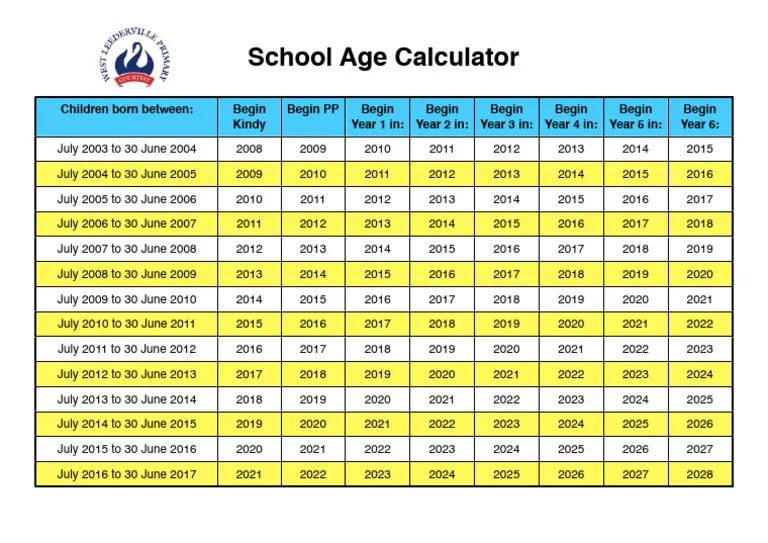
Here’s a visual school age calculator chart used by administrators:
Grade Level Age Calculator
Schools often need to verify that students are in age-appropriate grades. Here’s the typical age range by grade level:
| Grade Level | Typical Age Range | Cutoff Consideration |
|---|---|---|
| Kindergarten | 5-6 years | Must be 5 by September 1 |
| 1st Grade | 6-7 years | |
| 2nd Grade | 7-8 years | |
| 3rd Grade | 8-9 years | |
| 4th Grade | 9-10 years | |
| 5th Grade | 10-11 years | |
| Middle School | 11-14 years | |
| High School | 14-18 years | |
| 12th Grade | 17-18 years |
An education age calculator can quickly verify whether a student falls within the expected range or may need retention, acceleration, or evaluation.
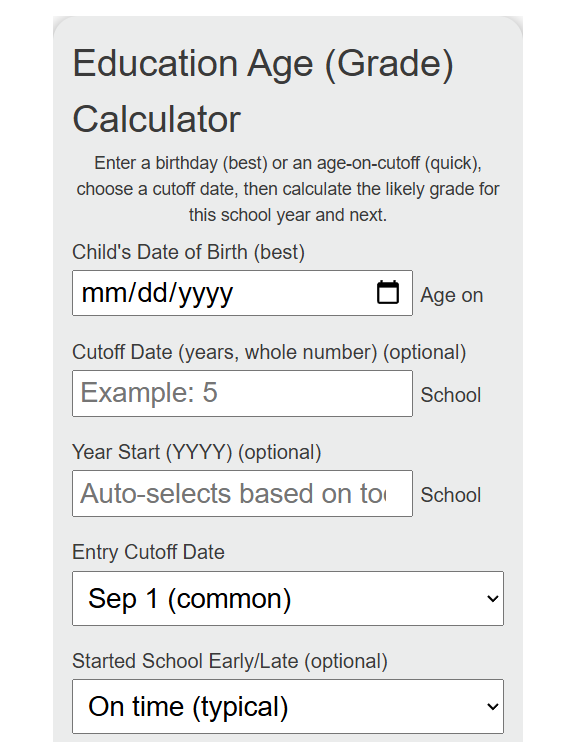
Here’s what an education age calculator interface looks like:
IEP Documentation and Special Education
For students receiving special education services, chronological age is critical at every stage:
Initial Evaluation
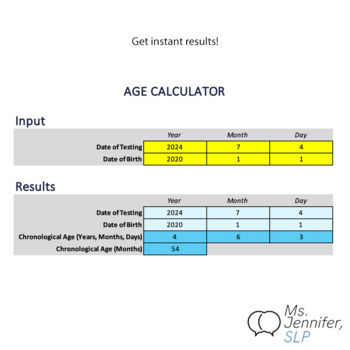
Psychologists and SLPs must document the child’s exact age at time of testing. Standardized assessments like the CELF-5, PPVT-5, and Brigance IED-III all use age-based norms. Using the wrong age means comparing the child to the wrong reference group — potentially leading to over-identification or under-identification of disabilities.
Here’s an SLP assessment age calculator in action:

IEP Meetings
Eligibility determinations and annual IEP reviews often need the child’s exact age on the meeting date. Entering the correct date prevents eligibility errors tied to cutoff ages.
Transition Planning
As students approach age 18, chronological age determines when they gain adult rights under IDEA (Individuals with Disabilities Education Act). Precise age tracking ensures timely transition planning.
Corrected Age for Premature Infants
For children born prematurely, schools and clinicians may need to calculate corrected age (also called adjusted age):
Corrected Age equals Chronological Age minus Weeks of Prematurity
For example, a child born 8 weeks early with a chronological age of 24 months has a corrected age of 22 months. This adjustment is crucial for developmental assessments in early childhood.
How to Calculate School Age Manually
For administrators verifying enrollment without a calculator:
- Identify the cutoff date (e.g., September 1, 2026)
- Subtract 5 years from the cutoff year (2021)
- Check the birth month and day against the cutoff
- If born on or before the cutoff: Eligible
- If born after the cutoff: Wait until next year
Example: Cutoff September 1, 2026
- Child born August 15, 2021: Eligible (turns 5 before cutoff)
- Child born September 10, 2021: Not eligible (turns 5 after cutoff)
FAQ: School Age Calculator
Q: What is the kindergarten age cutoff in most states? A: Most states require children to turn 5 by September 1, though some use August 1 or October 1. Check your local district’s policy.
Q: Can I use a chronological age calculator for IEP documentation? A: Yes — but ensure the calculator handles test dates correctly and outputs the format required by your assessment tool (years-months or years-months-days).
Q: What is corrected age and when do I use it? A: Corrected age adjusts for prematurity by subtracting weeks of early birth from chronological age. Use it for developmental assessments of children born before 37 weeks gestation.
Q: How do I calculate age in months for early intervention? A: Multiply years by 12 and add remaining months. A 2-year, 8-month-old child is 32 months old. Some calculators provide this automatically.
Q: Can a chronological age calculator determine grade placement? A: It can verify whether a child meets age requirements, but grade placement also considers academic readiness, social-emotional development, and parental preference.
Conclusion
A chronological age calculator is an indispensable tool for school administrators, special education teams, and enrollment offices. Whether verifying kindergarten eligibility, documenting IEP assessment ages, or tracking corrected age for premature infants, precision prevents errors that can affect a child’s educational trajectory. Choose a calculator that handles your district’s specific cutoff dates and outputs the format your assessments require