The Two Ways to Measure Age
Most people only know one number: their chronological age — the years since birth. But scientists, doctors, and longevity researchers are increasingly focused on a second, more revealing metric: biological age.
While chronological age is fixed and uniform, biological age varies dramatically between individuals. Two 40-year-olds might have biological ages of 35 and 50, reflecting vastly different health states. Understanding this distinction is essential for anyone interested in longevity, health optimization, or personalized medicine.
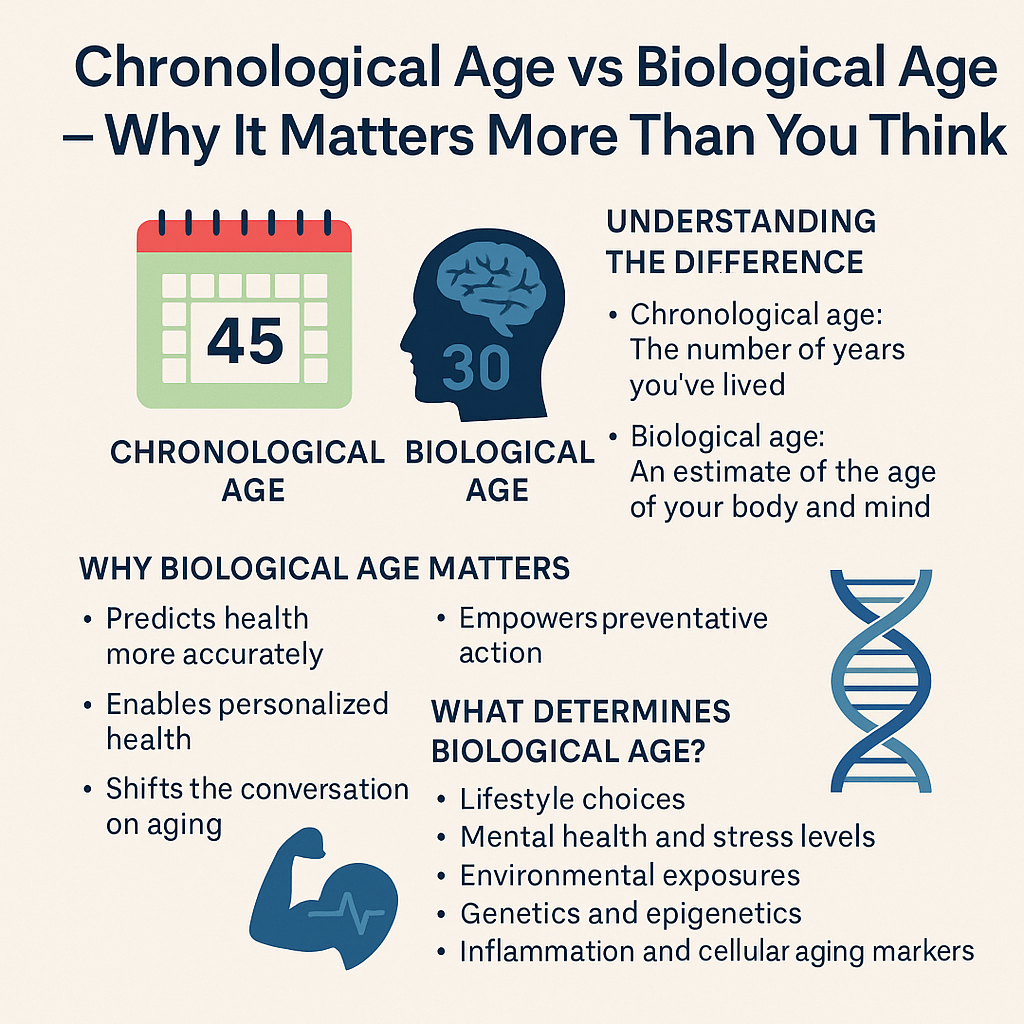
Here’s a visual comparison of the two concepts:
What Is Chronological Age?
Chronological age is the simplest measure: the time elapsed since birth. It is calculated by subtracting the birth date from the current date, accounting for leap years and variable month lengths.
Chronological age is used for legal age requirements like driving, voting, and drinking. Schools use it for enrollment cutoffs. Insurance companies use it for premium calculations. Medical professionals use it for dosing guidelines and developmental screening.
It is objective, unchangeable, and identical for everyone born on the same day.
What Is Biological Age?
Biological age (also called phenotypic age or health age) measures how well your body is functioning at a cellular and organ-system level. It reflects genetic factors and DNA methylation patterns, lifestyle choices like diet and exercise, environmental exposures such as pollution and toxins, stress levels and mental health, and chronic health conditions and inflammation.
Unlike chronological age, biological age is modifiable. Research confirms that lifestyle interventions can reduce biological age by 5 to 10 years.
Key Differences: Chronological Age vs Biological Age
| Aspect | Chronological Age | Biological Age |
|---|---|---|
| Definition | Years since birth | Functional age of body systems |
| Measurement | Fixed calculation from birthdate | Blood biomarkers, epigenetic markers, body composition |
| Can it change? | No — increases linearly | Yes — can be reduced through interventions |
| Health prediction | Weak correlation with outcomes | Strong predictor of mortality and disease |
| Variability | None (same for everyone born same day) | High — can differ by 20 plus years between individuals |
| Clinical utility | Administrative purposes | Personalized medicine, risk stratification |
How to Calculate Biological Age
Method 1: Blood Biomarker Analysis
The most accessible method analyzes standard blood test results. Key biomarkers include albumin and creatinine for kidney and liver function, glucose and HbA1c for metabolic health, total cholesterol and HDL for cardiovascular health, C-reactive protein for inflammation, and white blood cell count for immune function.
Advanced AI models trained on tens of thousands of samples can predict biological age with a mean absolute error of approximately 5.5 to 6 years.
Method 2: Epigenetic Clocks (DNA Methylation)
The gold standard measures DNA methylation at specific CpG sites. The Horvath clock uses 353 methylation sites and achieves an error of just 2.9 to 3.6 years. These tests require a blood or saliva sample sent to a specialized lab.
Method 3: Lifestyle Questionnaires
Free online biological age calculators estimate age based on diet, exercise, sleep, stress, smoking, and alcohol use. While less precise than lab tests, they provide valuable directional insights and motivation for lifestyle changes.
The Age Gap: What Your Number Means
Your age gap score is the difference between biological and chronological age:
- Negative gap (biological less than chronological): Your body is functioning younger than your years. Associated with lower disease risk and longer lifespan.
- Zero gap: Your biological age matches your chronological age.
- Positive gap (biological greater than chronological): Accelerated aging. Higher risk for cardiovascular disease, diabetes, and cognitive decline.
7 Proven Ways to Lower Your Biological Age
Research confirms these interventions can measurably reduce biological age markers:
- Regular exercise — Both aerobic and resistance training improve biomarkers
- Quality sleep — 7 to 9 hours optimizes cellular repair and hormone regulation
- Mediterranean-style diet — Rich in vegetables, fiber, omega-3s; low in processed foods
- Stress management — Chronic stress raises cortisol and shortens telomeres
- Quit smoking — Single most impactful change for biological age reduction
- Limit alcohol — Heavy consumption damages liver and accelerates aging
- Regular health screenings — Early detection prevents biological age acceleration
Studies show improvements can appear within 8 to 12 weeks of consistent lifestyle changes.
FAQ: Chronological Age vs Biological Age
Q: Can I calculate my biological age at home? A: Yes — online calculators provide estimates based on lifestyle factors. For clinical precision, blood biomarker analysis or DNA methylation testing is recommended.
Q: How often should I check my biological age? A: Experts recommend testing every 6 to 12 months to track trends. Single snapshots are less valuable than longitudinal data showing whether your interventions are working.
Q: Is biological age scientifically validated? A: Yes — epigenetic clocks like Horvath and GrimAge and blood-based calculators have been validated in peer-reviewed studies and correlate strongly with mortality and disease incidence.
Q: Can my biological age be younger than my chronological age? A: Absolutely. Healthy individuals often have biological ages 5 to 10 years below their chronological age. This is associated with reduced disease risk and increased longevity.
Conclusion
While chronological age tells you how long you’ve lived, biological age reveals how well you’re aging. The growing gap between these two numbers — and your ability to shrink it through lifestyle choices — represents one of the most empowering insights in modern health science. Start with a free biological age calculator, then consider blood-based testing for precision. Your chronological age is fixed, but your biological age is yours to improve.