A chronological age calculator is one of the most useful tools available today for anyone who needs to determine their exact age with precision. Whether you are filling out official documents, preparing for a medical assessment, or simply curious about how many years, months, and days you have lived, a chronological age calculator provides accurate results in seconds. This comprehensive guide explains what a chronological age calculator is, how it works, why accuracy matters, and how you can use it effectively in your daily life.
At its core, a chronological age calculator computes the precise difference between two calendar dates: your date of birth and a reference date, which is typically today or the date of a specific test or assessment. Unlike simple subtraction that only gives you a rounded number of years, a proper chronological age calculator accounts for varying month lengths, leap years, and the exact number of days between dates. This level of precision is essential for many professional and personal applications where approximate age simply is not good enough.
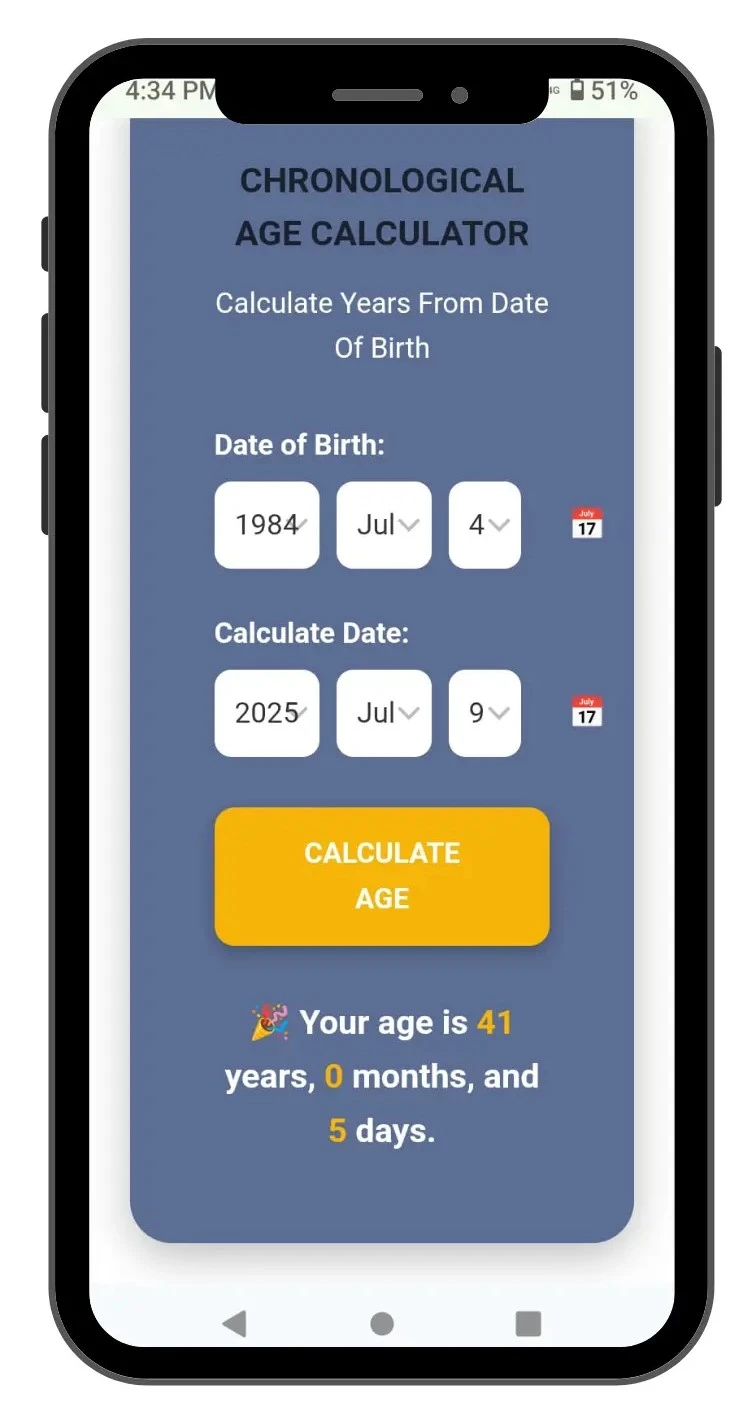
The formula behind every chronological age calculator follows a straightforward but careful process. First, the calculator subtracts the birth year from the reference year. Then it subtracts the birth month from the reference month. Finally, it subtracts the birth day from the reference day. When any of these subtractions result in a negative number, the calculator borrows from the next larger unit, just like regular arithmetic. For example, if the reference day is smaller than the birth day, the calculator borrows days from the previous month, reducing the month count by one and adding that month’s total days to the reference day before completing the subtraction. This borrowing method ensures that the chronological age calculator produces results that match real calendar time exactly.
Leap years present a special challenge that any reliable chronological age calculator must handle correctly. A leap year occurs every four years, adding an extra day to February. When someone is born on February 29, their birthday in non-leap years technically falls on February 28 or March 1, depending on the convention used. A sophisticated chronological age calculator accounts for these edge cases automatically, ensuring that ages calculated across leap year boundaries remain accurate and consistent. This attention to detail separates professional-grade calculators from basic age estimation tools.
The practical applications of a chronological age calculator extend far beyond simple curiosity. In education, teachers and school administrators use chronological age calculators to determine grade placement, eligibility for gifted programs, and special education services. Many standardized tests require the test-taker’s exact age on the testing date to select appropriate scoring norms. In healthcare, pediatricians and developmental specialists rely on chronological age calculators to track growth milestones, schedule vaccinations, and assess developmental progress against established benchmarks. Legal professionals use these tools to verify age for contract eligibility, voting rights, and age-of-consent determinations.
Using a chronological age calculator is remarkably simple. Most online tools require only two inputs: your date of birth and the reference date for which you want to calculate your age. After entering these dates, the calculator instantly displays your age broken down into years, months, and days. Some advanced calculators also provide additional information such as total days lived, total weeks lived, and the number of days until your next birthday. These extra details can be fascinating and useful for planning purposes.

When selecting a chronological age calculator, accuracy should be your top priority. The best calculators handle all calendar complexities automatically, including leap years, months with different day counts, and year-end boundaries. They should also present results in a clear, easy-to-read format that distinguishes between years, months, and days without ambiguity. Many professional calculators output results in the standard Y;M;D format used by educators, psychologists, and healthcare providers, making them ideal for official documentation.
Manual calculation of chronological age is possible but significantly more error-prone than using a dedicated calculator. The manual method requires writing both dates in year-month-day format, then subtracting each component separately while carefully applying borrowing rules when necessary. Even experienced professionals occasionally make mistakes with manual calculations, especially when dealing with dates near month boundaries or leap year transitions. For this reason, most experts recommend using a verified chronological age calculator for any situation where accuracy is important.
The growing popularity of chronological age calculators reflects broader trends in precision medicine, personalized education, and data-driven decision making. As society increasingly values individualized approaches to health and development, the demand for accurate age calculation tools continues to rise. Parents tracking their children’s milestones, athletes monitoring training age, and researchers studying aging populations all benefit from the precision that a good chronological age calculator provides.
For genealogists and family historians, chronological age calculators serve a unique purpose. When researching historical records, exact birth dates are not always available. Researchers may need to calculate age from baptismal records, census data, or immigration documents that list age rather than birth date. A reliable chronological age calculator helps verify whether records from different sources refer to the same individual by checking age consistency across documents.
In sports and athletics, chronological age determines eligibility for age-group competitions. Youth leagues, masters athletics, and senior games all use exact age to place competitors in fair groupings. Athletes and coaches use chronological age calculators to verify eligibility and plan training programs appropriate for the athlete’s developmental stage. Age-group records and rankings depend entirely on accurate age calculation.
In conclusion, a chronological age calculator is an indispensable tool for anyone who needs precise age information. From educational assessments to healthcare evaluations to legal documentation, accurate age calculation matters. By understanding how these calculators work and choosing a reliable tool, you can ensure that your age is always calculated correctly, down to the exact day.
The evolution of chronological age calculators reflects broader technological advancements. Early calculators were simple paper charts requiring manual counting. Today, sophisticated online tools handle complex calendar calculations instantly, with mobile apps for on-the-go use. Many calculators now include features like age comparison between multiple individuals and integration with calendar applications. These innovations make chronological age calculation more accessible than ever before, serving professionals and individuals across every field of human endeavor.