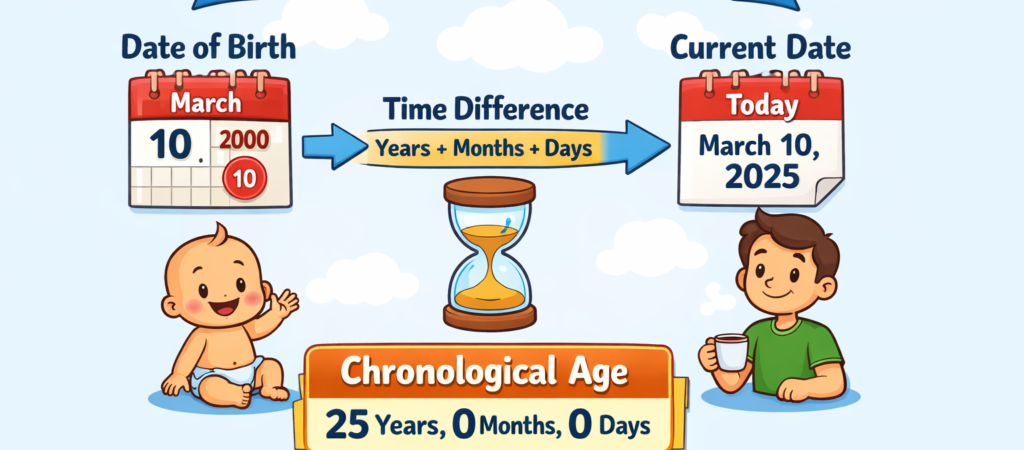
If you’ve ever filled out a school enrollment form, sat through a developmental screening, or helped score a standardized test, you’ve run into the term “chronological age.” It sounds like it should mean the same thing as “age,” and mostly it does — but the way it’s calculated, and why it matters, is more specific than most people realize.
Chronological Age, Defined
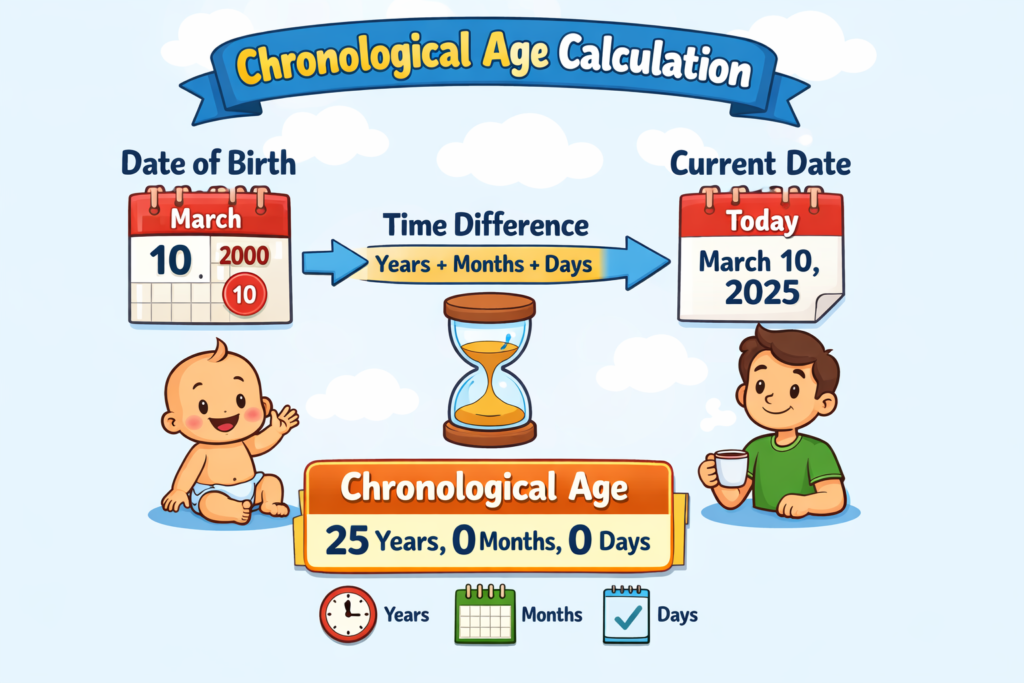
Chronological age (often abbreviated CA) is the exact length of time a person has been alive, measured from their date of birth to a specific reference date. That reference date might be today, but in professional settings it’s just as often a test date, a screening date, or a legal cutoff date.
The key word is exact. Chronological age isn’t rounded to the nearest year, and it isn’t expressed as a decimal like “7.4 years.” It’s broken into three columns — years, months, and days — because that’s the format most scoring tables, developmental milestones charts, and legal age requirements are built around.
Why Chronological Age Isn’t Just “How Old Someone Is”
In everyday conversation, nobody cares whether you’re 34 years, 2 months, and 11 days old — “34” is close enough. But chronological age shows up as a precise, load-bearing number in a few specific contexts:
- Standardized testing. Tests like the WISC-V, WPPSI, Bayley Scales, and PPVT convert a child’s raw test score into a standard score using an age-equivalent table. That table is indexed by exact years, months, and days — get the chronological age wrong by even a few weeks, and the score can shift into a different bracket.
- Developmental and speech-language screening. Clinicians compare a child’s performance to norms for their exact age band, not their “age in years.”
- School enrollment cutoffs. Many districts require a child to be a certain age, to the day, by a specific cutoff date to enroll in kindergarten or first grade.
- Legal and medical documentation. Consent forms, guardianship paperwork, and some medical protocols specify age requirements down to the day rather than the year.
The Formula: How Chronological Age Is Actually Calculated
Here’s where chronological age differs from a simple date subtraction. The standard method — the one used in most test administration manuals — works like a column subtraction problem, borrowing across columns the same way you’d borrow when subtracting large numbers by hand:
years  = test_year  − birth_year
months = test_month − birth_month
days   = test_day   − birth_day
If the days result comes out negative, you borrow: subtract one month, and add the number of days in the prior month to the days column. If the months result is negative after that, you borrow again: subtract one year, and add 12 to the months column.
Worked example: Birth date: June 20, 2015 Test date: July 14, 2026
- Years: 2026 − 2015 = 11
- Months: 7 − 6 = 1
- Days: 14 − 20 = −6 → negative, so borrow: months becomes 0, and days becomes −6 + 30 (days in June) = 24
Chronological age: 11 years, 0 months, 24 days.
This is a different result than you’d get from a plain calendar-day count divided into years and months, which is exactly why dedicated chronological age calculators exist — a generic “days between two dates” tool won’t produce the years/months/days breakdown that scoring manuals expect.
Should You Round the Months?
Some test manuals include a rounding convention: if the remaining days are 16 or more, round the month up; if 15 or fewer, drop the days and keep the month as-is. This isn’t universal — always check the specific manual you’re scoring against — but it’s common enough that a good calculator should offer it as an optional toggle rather than baking it in by default.
Calculate It Instantly
Doing this subtraction by hand is easy to get wrong, especially around month-end borrows (a birth date of January 31st, for instance, can require borrowing across more than one month). Use the calculator below to get an exact years/months/days result for any birth date and reference date, with the optional 16-day rounding rule built in.
Quick Recap
- Chronological age is exact time-alive, expressed in years, months, and days.
- It’s calculated with a borrow-based subtraction, not a simple date difference.
- It matters most in testing, screening, enrollment, and legal contexts where precision to the day affects an outcome.
- A dedicated calculator avoids the manual borrowing errors that come up around month and year boundaries.